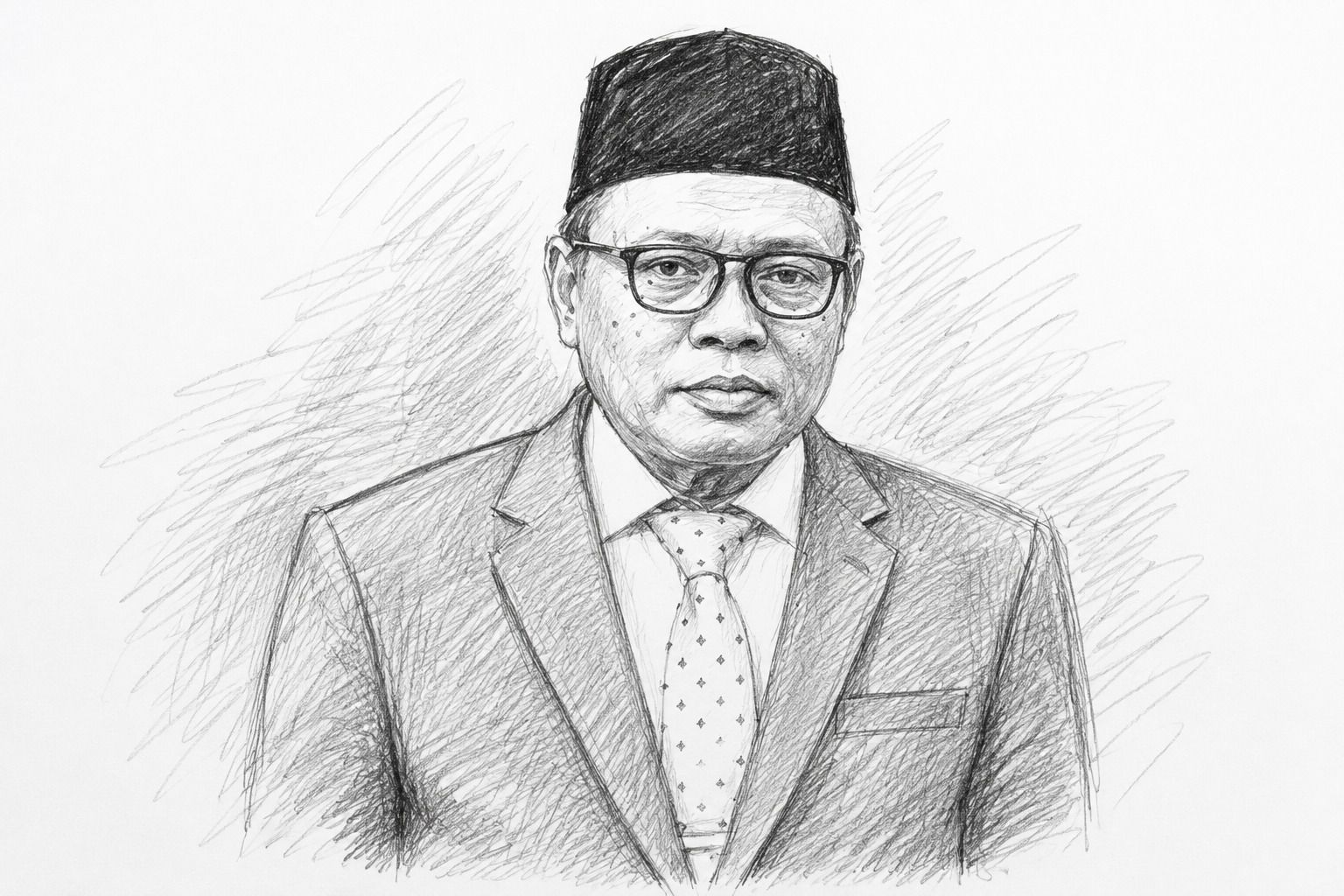
Selamat datang di ruang gagasan M. Tata Taufik.
Bagi saya, ilmu tidak cukup hanya dibicarakan di ruang kuliah, dituliskan dalam jurnal, atau disimpan di rak perpustakaan. Ilmu harus hadir dalam kehidupan, mengubah cara berpikir, membentuk manusia, dan memberi arah bagi masyarakat.
Website ini saya hadirkan sebagai rumah bagi gagasan-gagasan tersebut.
Di sini pembaca dapat menemukan artikel, catatan perjalanan, pemikiran tentang Al-Qur’an dan komunikasi Islam, pendidikan pesantren, kepemimpinan, kebudayaan, serta berbagai persoalan sosial yang kadang tampak sederhana, tetapi sebenarnya menyimpan pertanyaan besar.
Tidak semua tulisan di sini dimaksudkan sebagai kata akhir. Sebagiannya merupakan hasil penelitian, sebagian lagi adalah refleksi dari pengalaman, dan sebagian lainnya mungkin bermula dari kegelisahan—atau bahkan dari percakapan ringan yang ternyata terlalu menarik untuk dibiarkan berlalu begitu saja.
Saya percaya bahwa komunikasi bukan hanya kegiatan menyampaikan pesan. Komunikasi dapat membentuk cara manusia memahami dirinya, Tuhannya, orang lain, dan dunia tempat ia hidup. Dari komunikasi lahir pengetahuan; dari pengetahuan tumbuh kesadaran; dari kesadaran lahir tindakan; dan dari tindakan yang terus dipelihara, sebuah peradaban dibangun.
Karena itu, website ini bukan hanya tempat menyimpan tulisan. Ia adalah ruang untuk membaca, berpikir, berdialog, dan merawat harapan bahwa ilmu masih dapat bekerja bagi kemanusiaan.
Selamat membaca. Semoga setiap tulisan menemukan pembacanya, setiap gagasan memperoleh ruang dialognya, dan setiap ilmu dapat menjelma menjadi amal yang berguna.
Intellectual Biography and Educational Thought of Dr. M. Tata Taufik: Synthesizing Islamic Communication, Familial Pedagogy, and Pesantren Reform
Dr. M. Tata Taufik, M.Ag. (born 1966 in Kuningan, West Java) stands as a prominent figure in contemporary Indonesian Islamic education, media studies, and institutional governance. Serving as the leader (Pimpinan) of Pondok Modern Al-Ikhlash Ciawilor, Kuningan, and as Chairman of the Association of Indonesian Pesantren Caretakers (Perhimpunan Pengasuh Pesantren Indonesia / P2I), his career represents a structural integration of traditional Islamic scholarship (turats), modern communication theory, and progressive institutional reform.
His academic trajectory spans foundational classical Arabic training to doctoral-level media analysis, enabling him to construct novel frameworks such as transcendental communication theory and the familial approach to boarding school pedagogy. His intellectual contributions extend beyond local administration, engaging international academic forums across the Middle East, Europe, Australia, and the United States.
Educational Trajectory and Intellectual Lineage
The educational background of Dr. M. Tata Taufik reflects a deliberate progression from primary Islamic schooling to advanced interdisciplinary academic research. His early education began at Madrasah Ibtidaiyah (MI) Al-Ikhlash Ciawilor Kuningan, completed in 1979. To deepen his engagement with classical Islamic sciences and foreign languages, he enrolled in the Kulliyyatul Mu’allimin Al-Islamiyyah (KMI) at Pondok Modern Daarussalam Gontor, graduating in 1985. The Gontor curriculum provided him with a foundational grounding in Arabic and English, disciplined boarding life, and an appreciation for modern pedagogical structures.
Taufik pursued higher education at IAIN Syarif Hidayatullah Jakarta (now UIN Jakarta), earning a Bachelor’s degree (S1) in Arabic Language Pedagogy within the Faculty of Tarbiyah in 1992. His undergraduate thesis, Ta’lim al-Lughah al-Arabiyah ka-Amaliyati Takwin al-Dzauq, explored Arabic instruction as a mechanism for developing aesthetic and cultural sensibility. He continued his postgraduate studies at IAIN Sunan Gunung Djati Bandung, receiving a Master’s degree (S2) in Qur’anic Studies in 2001. His master’s thesis analyzed the linguistic characteristics of official Indonesian Ministry of Religious Affairs Qur’anic translations.
To address the emerging intersection of modern media and religious propagation, Taufik completed his Doctorate (S3) in Da’wah and Communication Science at UIN Syarif Hidayatullah Jakarta in 2007. His doctoral dissertation presented a formal Islamic critique of Western communication paradigms, laying the groundwork for his subsequent theoretical publications on Islamic media ethics.
| Degree Level | Institution | Field of Study / Specialization | Graduation Year |
| Primary / Basic | MI Al-Ikhlash Ciawilor, Kuningan | Basic Islamic Education | 1979 |
| Secondary | KMI Pondok Modern Daarussalam Gontor | Classical & Modern Islamic Pedagogy | 1985 |
| Bachelor (S1) | IAIN Syarif Hidayatullah Jakarta | Tarbiyah / Arabic Language Education | 1992 |
| Master (S2) | IAIN Sunan Gunung Djati Bandung | Qur’anic Studies (Studi Al-Qur’an) | 2001 |
| Doctorate (S3) | UIN Syarif Hidayatullah Jakarta | Da’wah and Communication Sciences | 2007 |
This sequence of academic qualifications demonstrates a transition from textual linguistics to theoretical communication science. By analyzing Qur’anic hermeneutics through the lens of modern media frameworks, Taufik established an academic paradigm that bridges classical Islamic textuality with contemporary communication systems.
Institutional Governance and Organizational Leadership
Development of Pondok Modern Al-Ikhlash
On July 16, 1990, Pondok Modern Al-Ikhlash was established in Ciawilor, Ciawigebang, Kuningan Regency, West Java, through the combined efforts of KH. Apandi BA, Drs. H. Ahim Absori, and Dr. M. Tata Taufik. Designed to function as a center for youth education and Islamic studies, the institution adopted the KMI Gontor educational framework, integrating classical Islamic disciplines (kitab kuning) with modern academic subjects, language immersion (Arabic and English), and structured extracurricular leadership programs. Under Taufik’s direct leadership, the institution achieved official recognition as a pesantren mu’adalah (equalized boarding school system), validating its internal curriculum for national and international university entry.
To meet expanding educational needs, Al-Ikhlash developed regional branches, including Pondok Pesantren Modern Al-Ikhlash Putri in Ciomas and Pesantren Daarul Mukhlisin in Cisantana. The educational system prioritizes character formation (adab), public speaking (khutbah), congregational leadership (imamah), and cross-cultural adaptability, partnering with international higher education institutions such as the International University of Africa in Sudan.
| Structural Domain | Leadership Role / Institution | Operational Term | Key Objectives & Scope |
| Pesantren Management | Pimpinan, Pondok Modern Al-Ikhlash Kuningan | 1990–Present | Academic administration, curriculum synthesis, international university linkages. |
| National Association | Chairman, Perhimpunan Pengasuh Pesantren Indonesia (P2I) | 2015–Present | National network governance, policy advocacy for recognized mu’adalah institutions. |
| Higher Education | Head of KPI Study Program, IAILM Tasikmalaya | 2009–2016 | Academic program design in Islamic Communication and Broadcasting. |
| Media Industry | Main Commissioner, PT. Radio Duta Muslim Kuningan | 2000–2012 | Strategic oversight of regional Islamic broadcasting. |
| Educational Advisory | Assessor AIBEP MORA & Consultant Bec-Tf MONE | 2008 / 2009 | Quality assessment for Islamic education programs and government projects. |
| Religious & Scout Boards | MUI Kuningan Board Member / Kwarnas Pramuka Advisory | 2010–Pres. / 2018–2022 | Regional fatwa council operations and national youth movement guidance. |
National Professional and Network Engagement
Taufik’s organizational leadership extends into national educational governance and civil society. Since 2015, he has served as Chairman of the Association of Indonesian Pesantren Caretakers (Perhimpunan Pengasuh Pesantren Indonesia / P2I), an organization facilitating institutional collaboration, quality assurance, and academic exchanges among Islamic boarding schools nationwide.
His administrative portfolio includes serving as Head of the Islamic Communication and Broadcasting (KPI) Department at IAILM Tasikmalaya (2009–2016), Main Commissioner of PT Radio Duta Muslim Kuningan (2000–2012), Assessor for the Australia-Indonesia Partnership for Basic Education (AIBEP MORA) in 2008, and Consultant for the Ministry of National Education (MONE) in 2009. Additionally, he serves as a board member of the Majelis Ulama Indonesia (MUI) in Kuningan Regency, trustee of the SCAN ADI Indonesia Foundation in Jakarta, and served on the Educational Advisory Board of the Scout Movement’s National Training Center (Pusdiklatnas Kwarnas) from 2018 to 2022.
Academic Contributions and Philosophical Frameworks
Islamic Communication and Transcendental Media Theory
Taufik’s theoretical work in communication challenges conventional, linear Western transmission models—such as Shannon-Weaver or Berlo models—which prioritize transactional efficiency, persuasive manipulation, or secular informational exchange. In his works, including Etika Komunikasi Islam (2012) and Memperkenalkan Komunikasi Transendental (2017), he argues that Islamic communication cannot be reduced to a set of mechanical techniques or utilitarian ethics.
Instead, he posits a transcendental communication paradigm rooted in Qur’anic epistemologies. Under this model, human speech (kalam) is inextricably linked to spiritual states, intellect (akal), emotional heart (qalb), divine guidance (hidayah), and moral accountability. Communication functions as a transformative, spiritual practice aimed at nurturing faith (iman), driving constructive personal action (amal), and establishing civilizational stability. His publication Dakwah Era Digital (2013/2020) and his specialized lexicon Kamus Istilah Komunikasi Islam (2017) further operationalize these theories, offering frameworks for navigating contemporary digital networks without compromising Islamic ethical norms.
The Familial Approach to Pesantren Pedagogy
In pesantren education, Taufik developed a systematic framework termed the “Familial Approach” (Pendekatan Kekeluargaan), documented in his 2026 monograph Familial Approach dalam Pendidikan Pesantren. Drawing on Family System Theory, this methodology frames the boarding school not as an impersonal administrative apparatus, but as an extended familial system.
Taufik advocates for a paradigm shift in institutional leadership, transitioning from transactional authority—characterized by rigid hierarchies, bureaucratic surveillance, and punitive enforcement—to relational governance based on emotional proximity, exemplary leadership (uswah), mutual trust, and positive expectation (husnuzan). By positioning kiais and educators as surrogate parental figures, this approach seeks to construct an emotionally secure learning environment. This environment balances strict behavioral discipline with relational warmth, mitigating psychological friction in residential learning contexts.
Holistic Curriculum, HOTS, and Educational Convergence
In recent years, Taufik’s research has focused on comparative pedagogical models and the formalization of implicit educational structures. In his 2023 study published in the International Journal of Educational and Psychological Sciences, titled Applying the Higher Order Thinking Skills in Modern Islamic Boarding Schools in Indonesia, he explored how classical pesantren practices (such as debate, fathul kutub, and peer-led discussion) naturally foster Higher Order Thinking Skills (HOTS).
Following this research, his 2024 work, Kumpulan Jurnal Inspiratif Benang Merah Sistem Pendidikan Finlandia dan Pesantren, alongside essays written for the Global Islamic Holistic Education Summit (GIHES), positioned pesantren education within broader international pedagogical developments. Taufik compares traditional pesantren systems with the Finnish education model, Japan’s Tokkatsu (holistic life-skills and character formation), and Child-to-Child Pedagogy. He argues for transforming the “hidden curriculum” inherent in round-the-clock boarding environments into an explicit, holistic curriculum. This framework redefines pesantren as dynamic leadership academies (kamarkazi li-al-hadlarah al-alamiyah) capable of addressing modern global challenges while maintaining their core spiritual identity.
International Engagement and Scholarly Diplomacy
Taufik’s international experience includes academic exchanges, institutional partnerships, and guest lectures across multiple regions. In 2008, he participated in the Partnership for Schools (P4S) program hosted by the East-West Center in Honolulu, Hawaii. In 2015, he completed specialized Arabic pedagogical training (Daurah I’dādu al-Mudarisin Lillagha al-Arabiyah) at Umm Al-Qura University in Makkah, Saudi Arabia.
He has presented research at international conferences, serving as a delegate to the 6th International Scientific Conference on Heritage and Civilization Studies at Suez Canal University in Egypt (2019), addressing the International Symposium at Daarul Fatwa Australia in Sydney (2019), participating in the International Scientific Forum in Trabzon, Turkey (2021), conducting school development visits in the United Kingdom (2022), and presenting at Sohar University in Oman (2024). Furthermore, he has been a frequent speaker at the International Arabic Language Conferences in Sharjah, UAE (including the 7th conference in 2024 and the 8th conference in 2026).
| Year | Event / Host Institution | Location | Nature of Engagement |
| 2008 | Partnership for Schools (P4S), East-West Center | Honolulu, Hawaii, USA | Educational Leadership Program |
| 2015 | Umm Al-Qura University | Makkah, Saudi Arabia | Arabic Language Pedagogy (Daurah) |
| 2019 | 6th International Scientific Conference, Suez Canal Univ. | Ismailia / Egypt | Indonesian Academic Delegate |
| 2019 | University Exchange & Academic Mission | Various Universities, Sudan | Bilateral Institutional Collaboration |
| 2019 | International Symposium, Daarul Fatwa Australia | Sydney, Australia | Guest Speaker on Media & Youth |
| 2021 | The International Scientific Forum | Trabzon, Turkey | Invited Conference Speaker |
| 2022 | UK School Development & Cultural Visit | United Kingdom | Comparative Educational Tour |
| 2024 | 7th International Arabic Language Conference | Sharjah, UAE | Speaker & Research Awardee |
| 2024 | International Conference, Sohar University | Sohar, Oman | Invited Academic Speaker |
| 2026 | 8th International Arabic Language Conference | Sharjah, UAE | Plenary Academic Presenter |
Scholarly Output and Institutional Honors
Selected Bibliography of Published Works
Taufik’s publications include monographs, peer-reviewed journal articles, specialized dictionaries, and edited volumes. His works focus on Islamic communication theory, pesantren institutional reform, translation studies, and Qur’anic exegesis.
| Publication Title | Publisher / Platform | Year | Core Thematic Focus |
| Terjemah Dari Teori Ke Praktek | Pustaka Al-Ikhlash | 2001 / 2003 | Translation theory applied to Arabic-Indonesian texts. |
| Manajemen Dakwah Era Global: Pendekatan Metodologis | Amisco / Fauzan Inti Kreasi | 2003 | Methodological frameworks for contemporary Islamic propagation. |
| Rekonstruksi Pesantren Masa Depan | PT Listafariska Putra | 2004 / 2005 | Structural transition from traditional to post-modern pesantren. |
| Etiket dalam Islam | Pustaka Al-Ikhlash | 2005 | Moral philosophy and behavioral etiquette in Islamic traditions. |
| Pendidikan Agama Bernuansa Kesehatan | Depag RI & LAPIS | 2007 | Integration of public health concepts into religious curricula. |
| Etika Komunikasi Islam | Pustaka Setia Bandung | 2008 / 2012 | Comparative critique of Western vs. Islamic media ethics. |
| Pedoman Pemberdayaan Masjid | CV. Alika | 2011 | Community empowerment through mosque administrative structures. |
| Dakwah Era Digital | Saaid.net / Yayasan Al-Ikhlash | 2013 / 2020 | Strategies for religious communication within digital media. |
| Tafsir Inspiratif | Wisemind / Elex Media / Quanta | 2015 / 2018 | Thematic Qur’anic exegesis geared toward personal reflection. |
| Kamus Istilah Komunikasi Islam | Wisemind & PP Al-Ikhlash | 2017 | Lexicography of specialized terminology in Islamic media. |
| Buku Putih Pesantren Muadalah | Forum Komunikasi Pesantren | 2020 | Legal and curricular documentation for recognized boarding schools. |
| Applying Higher Order Thinking Skills in Modern Islamic Boarding Schools | AIJEPS (Vol. 4, No. 7) | 2023 | Empirical analysis of HOTS in modern pesantren programming. |
| Benang Merah Sistem Pendidikan Finlandia dan Pesantren | Yayasan Islam Ta’limiyah | 2024 | Comparative analysis of Finnish holistic models & pesantren methods. |
| Affirmation of Islamic Boarding Schools as Leadership Schools | ARID Journal of Edu. & Psych. | 2025 | Institutional framework for pesantren as leadership academies. |
| Familial Approach dalam Pendidikan Pesantren | Yayasan Islam Ta’limiyah | 2026 | Systemic application of family system theory to boarding schools. |
Peer Recognition and Awards
Taufik has received awards recognizing his contributions to academic research, institutional leadership, and civil society. These honors originate from local government bodies, national organizations, and international academic platforms.
| Award Title | Granting / Awarding Body | Year | Field / Reason for Recognition |
| Penulis Kuningan (Kuningan Writer Award) | Disdikpora Kabupaten Kuningan | 2016 | Outstanding literary and academic contribution to regional literacy. |
| Medal of Scientific Leadership (وسام القيادة العلمية) | ARID Scientific Platform | 2023 | Academic leadership and research contributions across international platforms. |
| Medal of Social Responsibility (وسام المسؤولية الاجتماعية) | ARID Scientific Platform | 2024 | Institutional engagement and community-focused educational reform. |
| Best Research Award (أفضل البحوث) | Gulf States Educational Center for Arabic (Sharjah) | 2024 | Top research paper presented at the 7th International Arabic Conference. |
| Lencana Pancawarsa VI | Kwartir Nasional Gerakan Pramuka | 2024 | Twenty-five years of dedicated service to national scout character education. |
| Best Leader in Pesantren Education | ECDF EARTH LITERACY AWARDS | 2024 | Excellence in sustainable educational leadership and holistic boarding reform. |
Synthesis and Educational Outlook
Dr. M. Tata Taufik’s career illustrates a continuous effort to synthesize traditional Islamic boarding school education with modern pedagogical and communication frameworks. Through his work at Pondok Modern Al-Ikhlash and his leadership within the Perhimpunan Pengasuh Pesantren Indonesia (P2I), he has advocated for structural reforms that maintain Islamic ethical foundations while adopting contemporary pedagogical practices.
His theoretical contributions—including transcendental communication theory, the familial approach to residential education, and the integration of Higher Order Thinking Skills—offer models for operationalizing traditional Islamic principles within modern educational systems 1 . By engaging with comparative global models, such as Finnish holistic learning and Japanese Tokkatsu, his work situates the Indonesian pesantren not merely as a historical institution, but as an active participant in contemporary educational discourse.