
FROM QUR’ANIC INDEXES TO INSPIRATIONAL TAFSIR
When Readers Come with Keywords
M. Tata Taufik
Keywords and tables of contents. Two things that once seemed so ordinary have become the reader’s tools of choice. People do not always open a book intending to read it from the first page to the last. They scan the table of contents, follow a title that catches their attention, and stop where they think they might find what they need. The same happens when they search the internet. Before finding an answer, they must first decide which words to type into the search box.
This way of reading and seeking information raises a question for the development of Qur’anic interpretation. We already have many ways of helping people locate verses and understand their meanings. But what if someone is not looking for the name of a surah, the number of a verse, or an academic topic? What if they are looking for guidance on how to face something happening in their life?
Someone who is disappointed may have no idea which verse to read. All they know is that they are disappointed. A young person anxious about the future may not come asking for an interpretation of a particular surah; they may simply be looking for something to hold on to, so that they do not lose courage. Someone burdened by guilt looks for a way to put things right. Are these not precisely the moments when people most need guidance?
From indexing verses to seeking guidance
The effort to make the Qur’an easier to navigate is hardly new. Scholars and compilers of reference works have long helped readers locate verses through word arrangements, indexes, and thematic groupings. Muhammad Fu’ad ‘Abd al-Baqi, for example, compiled al-Mu’jam al-Mufahras li Alfaz al-Qur’an al-Karim, published in 1945. It is an index of Qur’anic words, not an index of human emotional states. Elsewhere, thematic indexes and thematic tafsir (tafsir mawdu’i) have made it easier for readers to trace verses dealing with particular subjects.
The benefits are considerable. Anyone who wants to find verses about patience, gratitude, repentance, family, or justice has a convenient point of entry. There is no need to search through the entire mushaf to locate the relevant passages. Such tools are intellectual achievements that deserve our appreciation.
Yet a small difference can have far-reaching consequences. An index answers the question, ‘Where are the verses about patience?’ Someone who has just suffered a failure may arrive with another question: ‘What can I do so that I do not give up?’ The first question looks for the location of a verse; the second looks for guidance in life. The two are connected, but they may not be answered by the same form of presentation.
Today’s information-seeking environment therefore offers an opportunity to present tafsir in a way that is closer to the reader’s experience. This does not mean replacing Qur’anic indexes, much less abandoning thematic interpretation. It means extending their usefulness: from finding the verse one is looking for to finding the guidance one needs.
Readers do not always come as passive recipients
The habit of going straight to a table of contents reflects a wider change in how people engage with messages. Readers and listeners have never been entirely passive, in the past or today. What has changed is that search technology makes their active role far more visible. People can begin with their own questions, choose among sources, compare results, and search again when the first answer does not seem sufficient.
In information-behaviour research, T. D. Wilson explains that information seeking begins with a need felt by an individual and leads that person to use available sources. This helps us understand why one piece of writing may matter deeply to one reader and seem quite ordinary to another. Their needs may differ, as may the time and circumstances in which they encounter the message.
We might describe the shift in emphasis as a move from the message receiver to the information seeker: from someone primarily presented with a message to someone actively searching for one. In this setting, presenting tafsir calls for attention not only to what the interpreter wants to explain, but also to the problem brought by the person seeking that explanation.
Titles, keywords, tables of contents, and the organization of material consequently take on a new significance. They are no longer merely accessories to book production. For readers searching for something to hold on to, they are doorways to an encounter with Qur’anic guidance.
Tafsir Inspiratif: when human needs become the point of entry
In the introduction to the first volume of Tafsir Inspiratif, the author gave a simple reason for putting the collection together. Not everyone has the opportunity to memorize the entire Qur’an or to understand Arabic. Besides, along life’s journey, a person often needs ‘something’—perhaps no more than a word or two—that can help in a particular situation. How wonderful it would be if that ‘something’ came from the verses of the Qur’an, the Word of God.
That observation is an important starting point. Verses are selected not simply because they are interesting to discuss, but because they may awaken and strengthen a person. In practice, Tafsir Inspiratif presents a verse and its translation, draws on established works of tafsir, and then sets out lessons readers may take from it. Inspiring titles and straightforward language are part of bringing the message closer to the reader.
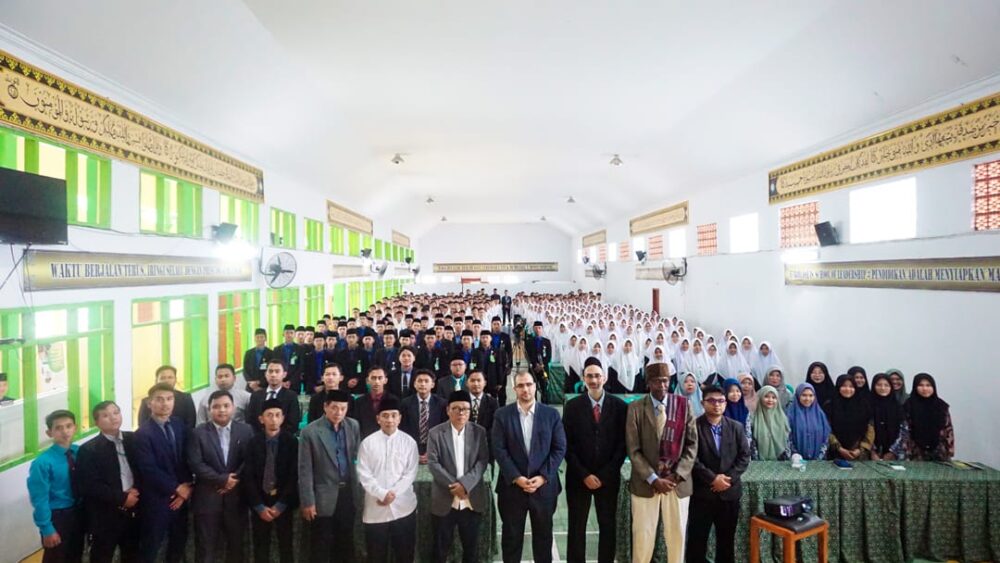
When the idea of Applied Tafsir (Tafsir Terapan) was introduced in a public lecture entitled Menggagas Tafsir Terapan on 17 June 2023, attention to the circumstances of everyday life was already identified as one of its principles of presentation. The term socio-emotional setting referred to the conditions surrounding the reader—enthusiasm, disappointment, sadness, happiness, anxiety, hope, and others. As a methodological element, it helps identify what a seeker of guidance needs. It does not authorize us to bend the meaning of a verse to fit a reader’s feelings. We look for relevant guidance while safeguarding the integrity of interpretation.
Tafsir Inspiratif thus offers a somewhat different point of entry. A reader does not have to begin by knowing a surah and verse number. They may begin with a question from life and then be guided to relevant verses, their interpretation, and lessons for attitudes and action. This is one expression of Applied Tafsir: interpretation that does not stop at providing information about a verse but seeks to bring the reader closer to the benefit of its guidance.
Four readers, four uses
A small set of responses to the first volume of Tafsir Inspiratif is worth considering. One reader said the book would be useful for a Mawlid sermon commemorating the Prophet’s birth. Another was especially drawn to a verse about repentance. A third complained, in good humour, that just as they were thoroughly enjoying the reading, the discussion came to an end. Someone else called it a tafsir that brought comfort in times of sorrow.
All four read the same book, yet each found something different. One found material to share with an audience; another found a message that spoke to a spiritual concern. One enjoyed the very act of reading, while another found consolation. An author may have a particular purpose in writing a book, but readers arrive with experiences and needs of their own.
These reactions are not sufficient evidence that the readers’ attitudes or behaviour actually changed. Still, as early observations, they offer clues to how a work of tafsir is received, how its usefulness is selected, and how readers make it meaningful. The same Qur’anic verse may meet people in very different circumstances. This is one reason the function of guidance deserves continued attention in the study of tafsir.
The Qur’an describes itself as guidance for humanity (Qur’an 2:185). In Qur’an 10:57, it is also described as an admonition, a healing for what is in the hearts, guidance, and mercy for believers. These functions suggest that a person’s relationship with the Qur’an does not end with knowing what its words say. There is also nurturing, reassurance, remembrance, and direction for life.
Organizing messages for those who are searching
If this is so, interpreters in the twenty-first century face an additional challenge. They must still understand verses through the established tools of Qur’anic interpretation, and their explanations must remain accountable to those tools. But they must also consider how the results of interpretation can be found easily, understood readily, and considered for use in daily life.
Imagine a table of contents that offers not only ‘Tafsir of Qur’an 94:5–8’ but also ‘When Your Efforts Have Not Succeeded, Should You Give Up?’ A reader struggling with failure may first notice the second title. The title offers an entrance through the reader’s problem and then invites them to understand the verse in context. A title does not replace interpretation. It leads the reader toward it.
Consider, too, someone searching for the word ‘repentance’. They need more than a list of verse numbers. An explanation of God’s forgiveness must be accompanied by an understanding of remorse, abandoning wrongdoing, making amends, and taking responsibility toward others when their rights have been violated. If we offer only reassuring words and neglect the fuller teachings of the faith, tafsir risks becoming little more than a passing motivational message.
The methodological innovation lies in bringing three things together in an orderly way: the reader’s needs, a sound understanding of the verse, and guidance that can be put into practice. A search may begin with a keyword drawn from everyday life, but the explanation must remain grounded in the principles of tafsir. Once the meaning has been understood, readers are invited to ask a simple question: what next? What must be recognized, left behind, corrected, or done?
In digital settings, this idea could be developed through indexes of human needs, inspiring titles, thematic tags, and pathways to related readings. The word ‘fear’, for example, might lead to several different questions: fear of failure, fear of loss, fear of doing wrong, or fear of responsibility. These need not all be answered by the same verse. Readers should be offered a range of relevant messages, together with explanations that preserve their contexts and the limits of their application.
From searching verses to seeking guidance
It is worth remembering that verse indexes, thematic tafsir, and Tafsir Inspiratif need not be treated as historical stages in which one replaces another. They can exist side by side. An index helps locate the text; thematic tafsir helps us understand a subject more fully; Tafsir Inspiratif pays closer attention to how that guidance meets a person’s needs along the course of life.
The emphasis falls increasingly on the reader’s questions. Alongside ‘Where can I find the verse?’ and ‘What does it mean?’, we must also make room for ‘What does it have to do with my circumstances?’ and ‘Now that I understand it, what should I do?’ Tafsir is thereby invited to serve not only as a source of knowledge, but also as a means of personal formation.
This challenge also reminds us that the reach of a message cannot be measured only by how many people read or access it. We need to ask whether readers find something relevant, whether they understand the interpretation accurately, and whether the guidance helps them shape their attitudes. The four responses described earlier offer a starting point for more systematic research questions, not proof of universal success.
Perhaps it is true that keywords and tables of contents are the reader’s tools of choice today. Yet behind the words typed into a search box and the titles selected from a list, there is often something deeper: doubt, hope, regret, joy, or the desire to become a better person. Here tafsir has an opportunity to be present—not merely as an answer returned by a search engine, but as an explanation of the Word of God that can awaken awareness and guide a life.
An index helps people find verses. Tafsir helps them understand the message of those verses. Tafsir Inspiratif seeks to help people find the guidance they need, and then asks: what comes next?
Someone opening a table of contents is not always looking for a page number. Sometimes they are looking for something to hold on to as they continue their journey through life.
References
The Qur’an, especially 2:185 and 10:57.
‘Abd al-Baqi, Muhammad Fu’ad. 1945. Al-Mu’jam al-Mufahras li Alfaz al-Qur’an al-Karim. Cairo: Dar al-Kutub al-Misriyyah.
Taufik, M. Tata. 2015. Tafsir Inspiratif. Depok: Wisemind Publishing. See especially the introduction (Muqaddimah).
Taufik, M. Tata. 2023. Menggagas Tafsir Terapan [Developing the Idea of Applied Tafsir]. Public lecture, Ma’had Aly Riyadul Jannah, Pondok Pesantren Asshiddiqiyah 2, Tangerang, 17 June.
Wilson, T. D. 1999. ‘Models in Information Behaviour Research.’ Journal of Documentation 55 (3): 249–270. https://doi.org/10.1108/EUM0000000007145.
Hearst, Marti A. 2009. Search User Interfaces. Cambridge: Cambridge University Press, chapter ‘Models of the Information Seeking Process.’
Yusufa, Uun. 2015. ‘Kerangka Paradigmatis Metode Tafsir Tematik Akademik: Kasus Disertasi UIN Yogyakarta dan Jakarta.’ Journal of Qur’an and Hadith Studies 4 (2): 191–214.